
 By
By Partner yoga combines physical alignment with emotional connection, transforming a solo practice into an experience of mutual support and trust. In Singapore, where busy lifestyles often limit meaningful interaction, practising yoga with a partner can foster both physical well-being and interpersonal bonding. When the yoga wheel is introduced into partner yoga, it brings a new dimension of creativity and depth, enabling two people to assist each other in achieving greater flexibility, balance, and mindfulness together.
The Essence of Partner Yoga
Partner yoga is not just about synchronising movements. It’s about creating balance between giving and receiving, listening to each other’s bodies, and building communication beyond words. Through touch and coordinated breathing, both partners learn to trust and rely on each other.
Adding a yoga wheel enhances this shared experience. It acts as both a physical prop and a symbolic bridge, helping partners find common ground in movement and intention.
Why Incorporate a Yoga Wheel in Partner Yoga
The yoga wheel introduces versatility and challenge to traditional partner poses. Its curved design supports deeper stretches, improves balance, and makes certain postures more accessible. More importantly, it allows each partner to focus on awareness and connection rather than force.
Key benefits of including the wheel:
-
Encourages cooperative stretching and alignment.
-
Deepens flexibility without strain.
-
Improves balance and stability during shared poses.
-
Builds trust as each partner supports the other’s progress.
-
Promotes mindfulness through synchronised breathing.
This fusion of teamwork and technique helps strengthen both the body and the relationship.
Establishing Connection Before Practice
Before starting, spend a few minutes centring together. Sit face-to-face, close your eyes, and take deep breaths in unison. This helps establish rhythm and awareness. A few light warm-up stretches can help loosen the muscles before incorporating the wheel.
Preparation tips:
-
Communicate clearly and often.
-
Move slowly and check each other’s comfort levels.
-
Avoid competition; focus on collaboration.
-
Maintain steady breathing throughout.
Beginner-Friendly Partner Poses with the Yoga Wheel
The following poses are suitable for all levels and provide a foundation for deeper connection.
1. Seated Heart Opener
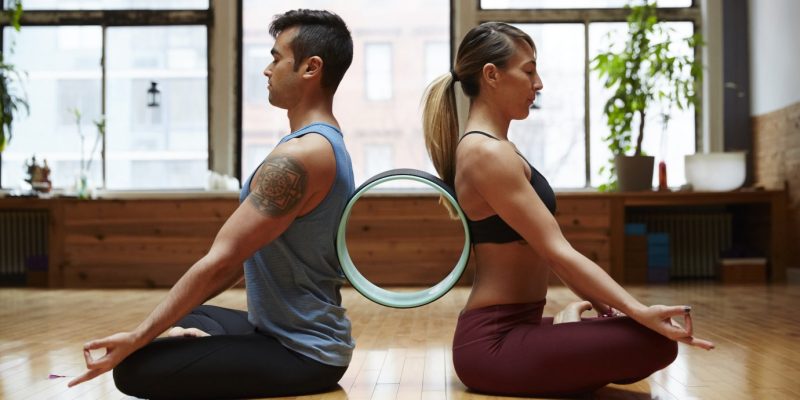
Sit back-to-back with the yoga wheel placed between your spines. As one partner leans gently backward, the other follows the motion. The wheel rolls between both backs, allowing simultaneous chest expansion.
Benefits:
-
Opens the heart and chest.
-
Enhances posture and shoulder flexibility.
-
Builds physical awareness of shared movement.
2. Partner Forward Fold and Backbend
Face each other and hold hands. One partner places the wheel under their back for support while leaning into a gentle backbend. The other partner folds forward, stretching the hamstrings and spine.
Focus: Maintain equal resistance through the arms to balance tension and support.
3. Assisted Shoulder Stretch
Stand facing each other with the wheel held between your palms. One partner rolls it forward slightly while both lean into the stretch, keeping their chests open.
Purpose: Releases shoulder tightness and improves joint flexibility.
4. Supported Downward Dog and Assisted Chest Opener
Partner A takes a Downward Dog position. Partner B places the wheel under their chest and rests their hands on Partner A’s back. As they roll forward, Partner B stretches deeply while Partner A strengthens the shoulders.
Benefits:
-
Builds strength and balance.
-
Encourages teamwork through physical alignment.
Intermediate Poses for Trust and Balance
As confidence grows, partners can explore more challenging movements that require coordination and balance.
1. Standing Wheel Balance
Stand side by side, each holding one end of the wheel. As you lift the opposite leg into Tree Pose, use the wheel for balance. This exercise promotes synchronicity and trust.
2. Partner-Assisted Camel Pose
Partner A kneels with the wheel behind their back. Partner B stands behind and gently holds their shoulders for support as A leans back over the wheel.
Focus: Breathe together and maintain gentle communication to ensure safety.
3. Wheel Bridge and Supported Stretch
Partner A lies on their back with the wheel under the sacrum. Partner B sits near the head and holds Partner A’s hands, gently pulling upward. This assists in opening the chest and releasing lower back tension.
Result: A rejuvenating combination of support and surrender.
Deepening Emotional Connection Through Shared Practice
Beyond physical poses, partner yoga with a wheel strengthens emotional bonds. The act of balancing and moving together fosters non-verbal communication, empathy, and patience. The trust built through these exercises often extends beyond the mat, improving understanding in daily interactions.
How the practice nurtures connection:
-
Eye contact: Encourages presence and vulnerability.
-
Breath synchronisation: Creates calm and unity.
-
Touch awareness: Promotes sensitivity and mutual respect.
-
Shared laughter: Eases tension and builds comfort.
For couples or friends in Singapore looking for mindful bonding experiences, this form of yoga serves as a refreshing alternative to typical fitness routines.
Restorative and Cooling Partner Wheel Poses
To close a session, restorative poses with the yoga wheel help release tension and calm the nervous system.
Examples include:
-
Reclined Bound Angle with Shared Wheel Support: Sit facing each other with soles of the feet together. Place the wheel under your backs as you lean into a supported recline.
-
Seated Twist Connection: Sit side by side with the wheel between you. Twist gently in opposite directions, supporting each other’s movements.
-
Paired Savasana: Lie on the mat with your partner’s feet touching yours and the wheel under your knees. Focus on breathing in harmony.
These closing poses allow both participants to release any residual tension while maintaining a sense of connection and stillness.
Integrating Partner Yoga into Weekly Practice
You don’t need to dedicate an entire session to partner yoga. A few shared postures once or twice a week can make a noticeable difference in flexibility, coordination, and emotional bonding.
Suggestions for consistent practice:
-
Include partner warm-ups during regular classes.
-
Alternate between strength-building and restorative poses.
-
Use the wheel for joint stretches at the end of individual practices.
Studios like Yoga Edition often include creative wheel-based variations that encourage collaboration, making advanced poses accessible while maintaining safety and enjoyment.
The Role of Communication and Awareness
Communication is the foundation of every partner yoga session. Both practitioners must express their limits and provide feedback throughout the flow. The yoga wheel magnifies this awareness since it requires control and synchronisation to maintain balance.
Simple cues to remember:
-
Always announce transitions before moving.
-
Keep your breathing steady and audible.
-
Use verbal and non-verbal signals to guide each other.
-
Focus on awareness rather than achieving perfection.
As trust deepens, communication becomes intuitive, allowing movements to flow effortlessly.
Safety Tips for Partner Yoga with the Wheel
Although this practice can be playful, safety remains a priority.
-
Avoid attempting advanced poses without sufficient warm-up.
-
Do not place full body weight on your partner unexpectedly.
-
Maintain focus and avoid sudden movements.
-
Use a stable surface and a non-slip mat.
-
Respect your partner’s comfort and boundaries.
These precautions ensure that the session remains enjoyable and injury-free.
Long-Term Benefits for Body and Relationship
Practising partner yoga with the wheel offers both physical and emotional rewards. Over time, you may notice:
-
Improved spinal flexibility and shoulder mobility.
-
Better balance and alignment.
-
Stronger emotional connection with your partner.
-
Reduced stress and increased relaxation.
-
Enhanced awareness of mutual rhythm and energy.
These results make the practice an enriching addition to both personal wellness and relationship growth.
FAQs
Q1. Can beginners try partner yoga with the wheel?
Yes. Start with simple stretches and supported poses. The key is to prioritise comfort and control rather than depth.
Q2. Do I need to be flexible to participate?
No. Partner yoga focuses on cooperation, not flexibility. The wheel helps both partners reach deeper stretches safely, regardless of experience level.
Q3. Can this be practised outside a studio?
Definitely. You can practise at home, in parks, or on rooftops as long as there’s a flat surface.
Q4. Is partner yoga suitable for couples only?
Not at all. It can be practised with friends, family members, or even colleagues as a trust-building activity.
Q5. How often should I practise partner yoga with the wheel?
Once or twice a week is sufficient to see benefits. Consistency is more important than duration.
Partner yoga with the wheel is a reminder that growth, in both yoga and relationships, comes from cooperation, patience, and shared intention. Through this practice, two people learn to move, breathe, and trust together, discovering a deeper sense of harmony both on and off the mat.